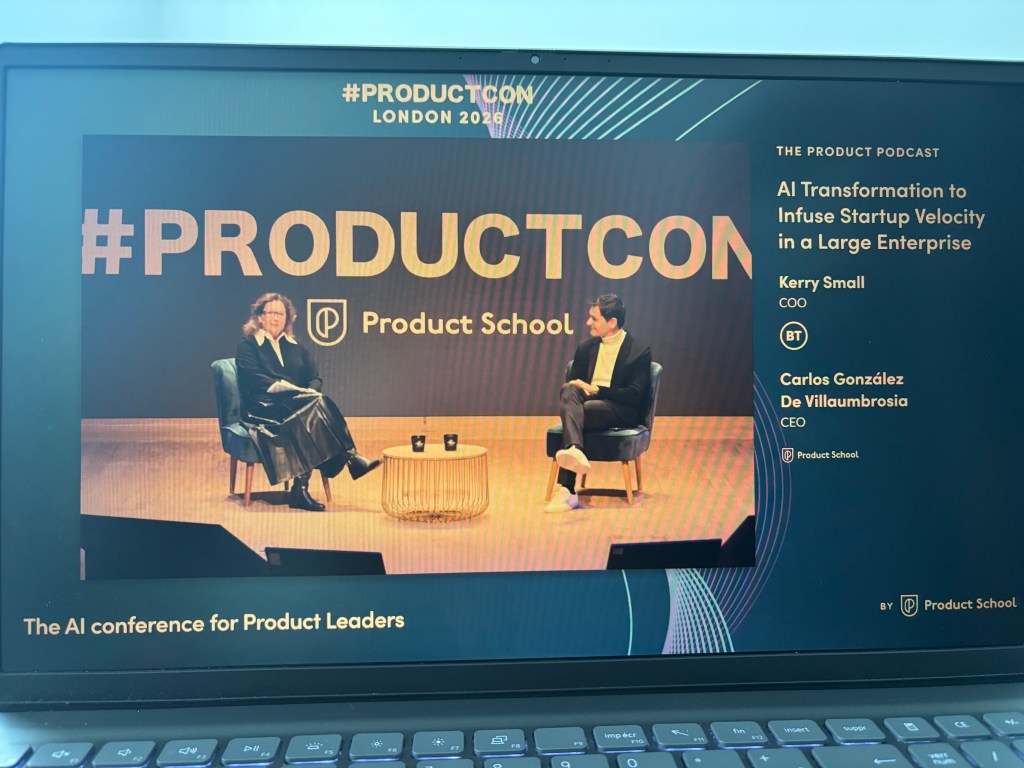
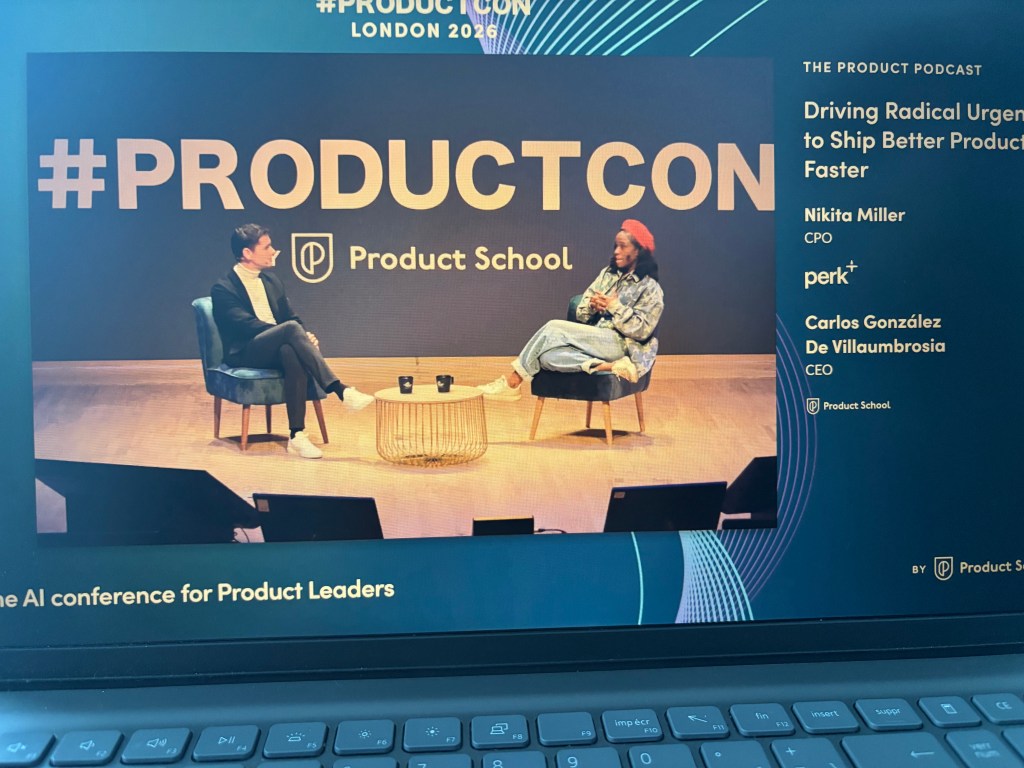
I attended ProductCon virtually today. Alone behind my screen, yes. Lonely? Not really.
For a few hours, I listened to CPOs, COOs, and VPs share what it actually looks like to lead product at scale — at BT Group, Perk, Mastercard, Just Eat, Miro, The Economist. Not the polished version. The operational one.
What I took away wasn’t a magic formula. It was more like clarity on things I’d already felt but hadn’t named yet.
AI doesn’t fix a broken foundation. Jessica Hall from Just Eat said it plainly: AI exposes broken organizations, it doesn’t save them. Before chasing the next tool, the question is — do we even know what problem we’re solving? Do we have the data foundation to support what we’re building?
Speed and quality aren’t opposites. Nikita Miller from Perk walked into a full platform relaunch and kept the team moving without burning them out. Her framing stuck with me: go from ideation to creation fast, but know when to slow down before you accelerate again. The urgency is real. So is the judgment required to pace it.
The PM role is shifting — and it’s not subtle. Kerry Small at BT Group talked about rethinking PM-to-engineering ratios for the AI era. Brent Barkman at Miro described engineers designing and designers coding. The old lanes are blurring. What stays constant is the need for clarity — on the problem, the outcome, the user.
Ownership matters more than titles. Maria Parpou at Mastercard made the case that CPOs need to act like general managers — owning the P&L, shaping distribution, telling a business story, not just a product one. It’s a different kind of accountability.
And from Pavel Fabrikantov at Semrush, something I hadn’t fully considered: AI is already making discovery decisions upstream. Your product is being found — or not — before a human ever searches for it. GEO (Generative Engine Optimization) is the new SEO, and most product teams aren’t thinking about it yet.
Three things I’m taking into practice from here:
- Run a clarity audit on my own work. Before adding anything, ask: what’s the actual problem? What does success look like? Is there a data foundation to measure it?
- Practice the “outcome first” reflex. Less feature-think, more result-think. Ship toward something measurable, not just something shippable.
- Pay attention to how AI surfaces products — including mine. Start experimenting with how content and data are structured for machine-readability, not just human readers.
No badge. No networking lunch. But real takeaways. And that’s enough for now.
 norosoa francia razafimahaleo